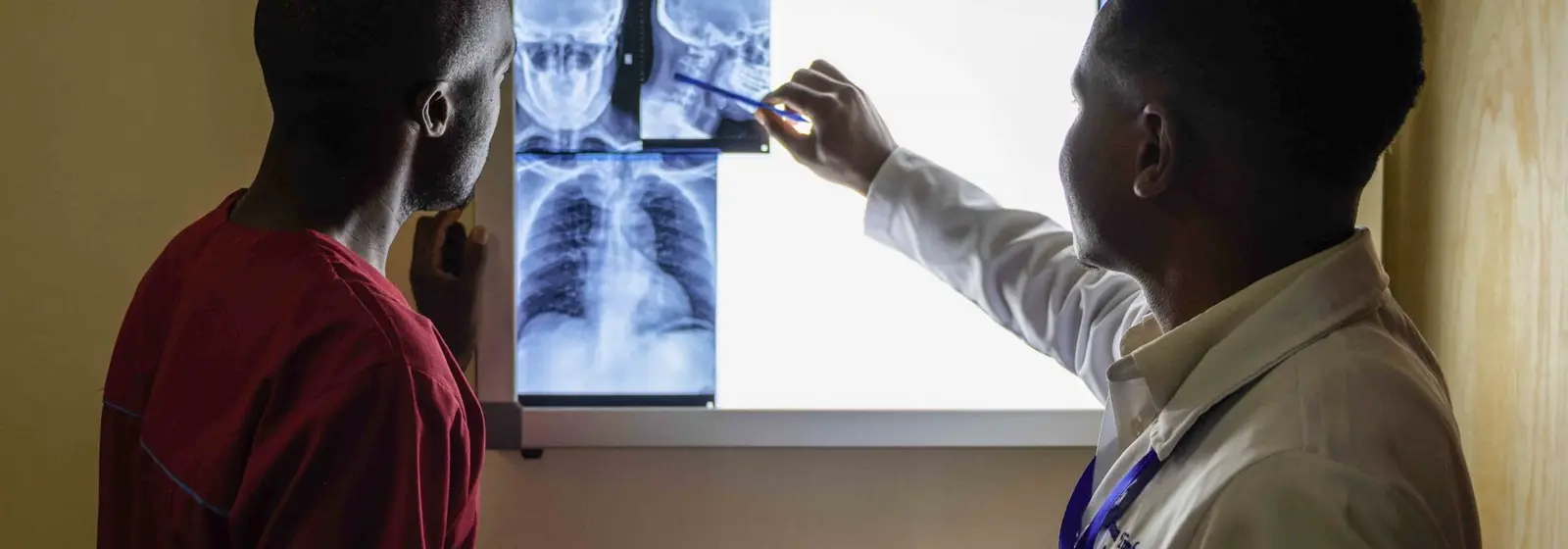
HMIE, the H-Link Medical Intelligent Engine, runs open medical models on servers we control. Each feature does one task, shows its sources where it has them, and leaves the decision to the clinician. Where a number can be calculated, it is calculated, not guessed by a language model.
Two things that can carry clinical text do leave our servers: questions typed into the knowledge assistant go to Google to find matching sources, and the live dictation preview uses your browser’s own speech service (Google in Chrome, Microsoft in Edge). Stock and catalogue tools, which carry no patient data, can also use cloud AI.
Patient data goes from the clinician to HMIE, the H-Link Medical Intelligent Engine, on servers we
control, and a suggestion comes back for the clinician to decide on. Cited medical sources feed the
knowledge assistant. Sending patient data to cloud AI companies is refused. Two things that can carry clinical text do leave our servers: questions typed into the knowledge assistant go to Google to find matching sources, and the live dictation preview uses your browser’s own speech service (Google in Chrome, Microsoft in Edge). Stock and catalogue tools, which carry no patient data, can also use cloud AI.
The problem
What it is built to fix
Too few specialists
A medical officer in a district hospital is often the most senior clinician for miles, with no one to ask.
Documentation eats the day
Time spent writing notes and coding diagnoses is time not spent with patients.
Black-box answers
A confident answer with no source is dangerous in medicine. Clinicians need to see why.
Capabilities
What Clinical intelligence does
Clinical decision support
Suggestions a clinician can review, accept or discard — never an automatic decision.
What is included in Clinical decision support:4 items
Differential diagnosis and red-flag support from the recorded findings
Laboratory result interpretation
Drug interaction and dosing checks
Most AI calls logged with the model version that answered them
A knowledge base with citations
Answers drawn from medical literature, with each statement linked to the source it came from.
What is included in A knowledge base with citations:3 items
Numbered citations on every answer
Links to the published source
Sources listed beneath every answer
Smart Doc: documentation and coding
Less typing, more consulting.
What is included in Smart Doc: documentation and coding:5 items
Dictation turned into a clinical note for the clinician to review
Chart, shift-handover and pre-visit summaries
On ward rounds, dictation fills the form fields, and the clinician ticks what is applied
ICD-10 code suggestions
Speech recognition for Twi, Ewe, Dagbani and Ga, in development with Ghanaian speakers
Operational forecasting
The numbers are calculated with statistics, not guessed by a language model.
What is included in Operational forecasting:3 items
Demand forecasts with confidence ranges and stock-out dates
Safety stock and reorder points
Supplier scorecards
Claims checked against the note
A second read of an NHIS claim before it goes out, claim by claim.
What is included in Claims checked against the note:3 items
Flags codes the note does not support, and care the claim leaves out
Every finding quotes the line of the note it came from
Advisory: the claims officer decides, and every review is kept
Workflow
From question to decision
Ask
The clinician dictates, asks a question or opens a chart.
Suggest
HMIE drafts a note, a differential or a code.
Show sources
Knowledge answers carry numbered citations to the published source.
Decide
The clinician accepts, edits or discards it.
Record
Most decision-support calls are logged with the model version that answered.
Frequently asked questions
What is HMIE?
The H-Link Medical Intelligent Engine: the layer that runs H-Link’s clinical AI. It uses open medical models, in a small and a large size, on servers we control, and each feature calls it for one task.
Does the AI make clinical decisions?
No. Every feature presents a suggestion for a clinician to review. The clinician decides, and remains responsible for the decision. None of these features has regulatory approval as a medical device.
Where is patient data processed for AI features?
Patient-data AI features run on HMIE, on GPU servers we control at a hosting provider named in our sub-processor list. A guard in the software refuses to send those requests to cloud AI companies, and an automated check blocks new code that connects to them directly. Two things that can carry clinical text do leave our servers: questions typed into the knowledge assistant go to Google to find matching sources, and the live dictation preview uses your browser’s own speech service (Google in Chrome, Microsoft in Edge). Stock and catalogue tools, which carry no patient data, can also use cloud AI.
Is patient data used to improve the AI?
In some features, yes, and only on the terms we agree with your facility. Screening images are kept for model improvement only when the patient’s consent is recorded, and clinicians’ corrections to AI suggestions are used to evaluate and improve those features. We agree how your facility’s data may be used before go-live.
Tell us how your facility runs today. We will show you the platform on the departments you care about, and scope a pilot with the numbers agreed up front.